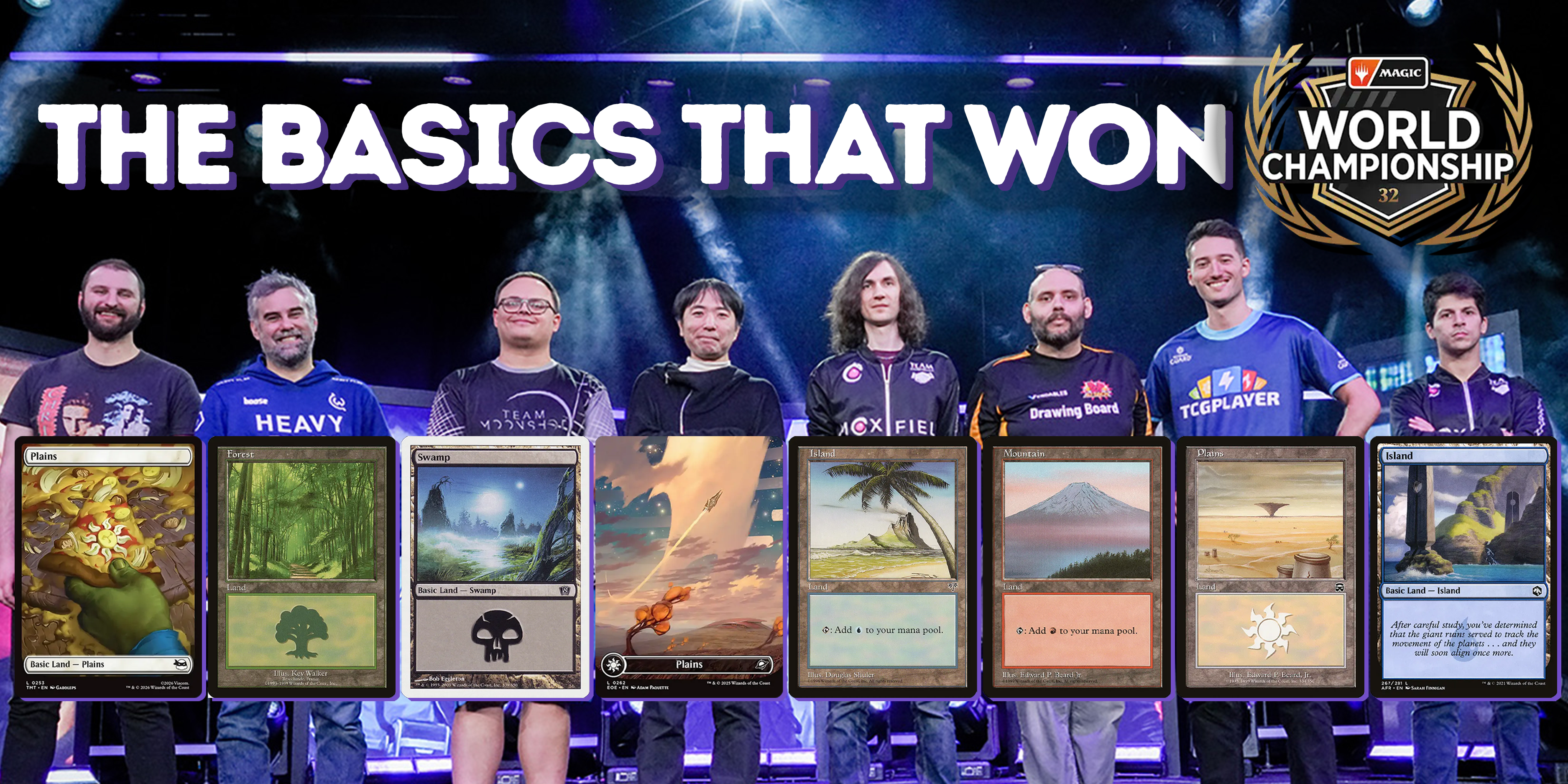
Stefan Schütz took home the title of the 32nd Magic: the Gathering World Champion on Sunday on the back of extraordinary gameplay and a creatureless deck headlined by an auspicious uncommon enchantment from Star Trek that hardly drew attention during spoiler season. More important than Anthropological Mission, however, was Stefan’s classy decision for which basic lands to sleeve up in his Izzet deck: a gorgeous Mirage Island that features a palm tree not dissimilar from the card’s set symbol.
That’s right, we’re once again highlighting the basic lands that took the top tables at Magic’s biggest events of the year, this time the 32nd World Championships in Atlanta, Georgia. Sure, the top eight was made up of eight different archetypes, a rarity for a competitive event. That’s something to celebrate! But even more delightful is the lack of duplicates in these players’ basic land choices.
When you’re at the highest levels of competitive play, your choice of deck is often determined by your read on the meta, or what your team collectively decided you would all play with, so deck choice is rarely motivated by personal style or taste. Where players can show off their flair best of all at Magic’s biggest event, then, is in which of the 2,000+ basic lands they sleeve up. Here’s what the Top 8 of the 32nd World Championship chose:

Before we go into any players’ specific choices, I do want to highlight a particularly notable element here: this is the first Top 8 we’ve covered here at Cardboard by the Numbers without a single player running one of the Un-sets. Unhinged in particular has been a mainstay at top tables across every Magic event I’ve ever been to in three continents, and yet not a single player both used the John Avon classics and took home more than $20,000 in prizes.
Starting off with winner Stefan Schütz, as previously mentioned, his deck only featured a single type of basic land, and he used Douglas Shuler’s Mirage Island for all six slots. We covered his last Top 8 performance just earlier this year in Las Vegas, where he also opted for Mirage basics. Mr. Schütz knows what he likes, and that’s respectable when he has such good taste.
Both second and third place used promo lands from the game’s first decade that featured real-life vistas from Earth depicted on Magic cards during an era where that was a rarity. Eduardo Sajgalik opted for one of the game’s most picturesque Plains featuring Eric Peterson’s depiction of Netherlands’ lowlands and a Forest by Kev Walker representing an enchanted walk through the woods in Brittany.

Third place Kellen Pastore preferred the earlier APAC lands and was not fussed about sticking to a single Mountain, as both the iconic Mt. Fuji by artist Edward P. Beard, Jr. and Rebecca Guay’s Taiwanese canyon were included in his 75 alongside a Plains set in China — also by Guay.
In fourth place, the Australian James Drake ran the most conventional deck — a Selesnya Landfall list nearly unchanged from last month’s biggest tournaments — but certainly the least conventional basic lands: the ire-inducing “pizza lands” from Teenage Mutant Ninja Turtles, both illustrated by Gaboleps. I respect it, to be honest. I generally personally dislike lands that do not reflect “land” for personal, Vorthos-related reasons, but the grotesque and convention-breaking nature of these cards is a statement in their own right. I wouldn’t be surprised if the tilting nature of these basics gave some small advantage to Mr. Drake over the course of the championship.
We have three more players with conventional basic lands in the top 8, making this, again, a stunning return to form when more than 50% of all new basic lands are full-art these days. I am a fan of Charis Kikidis’ Adventures in Forgotten Realms basics, both for their art and for the evocative flavor-text that joins the text box. Abe Schnake’s 8th Edition lands have excellent art but a jarring white border, but that’s often seen as a practical decision to help find them while searching one’s deck. Arne Huschenbeth chose a pair of basics from Mercadian Masques that are pleasant, if unremarkable.
But I want to give a special shoutout to the 7th place finisher, Shuhei Nakamura, who ran the Edge of Eternities “Celestial” full-art lands. Not only is this cycle stunning across the board, but I appreciate that at a weekend celebrating the new Star Trek expansion where nearly half of the event’s games were dedicated to Star Trek limited, Mr. Nakamura decided to stay on-theme with cosmic basics. The Hall of Famer hasn’t been on the pro circuit in a while, so we’re extremely glad to see a favorite player back in action with some of the best basics around.
I encourage all of you reading to check out the deck lists for the top 8 players and watch some of the event on YouTube if you have the time — there were some great games of Magic played in Atlanta this weekend.
What are your favorite lands of the bunch? Who do you think is the style winner of the World Championship? Let us know in the comments or on our social channels, and thanks so much for reading! If you’ve enjoyed this article, sign up for our newsletter and be sure to follow us on Facebook, Instagram, Twitter, and Threads!!
Miles Atherton is the editor-in-chief of “Cardboard by the Numbers” and has been playing Magic since 2006. Since studying Agricultural Economics at UC Davis, he’s built a career as an award-winning marketer with a love of data journalism. He currently runs the anime & manga consulting firm White Box Entertainment and serves on the board for Manga Mavericks and Anime Trending. He’s previously written for Anime Trending, Anime Buscience, Anime News Network, and Crunchyroll News, serving as Executive Editor of the last from 2016 to 2021.
Leave a Reply