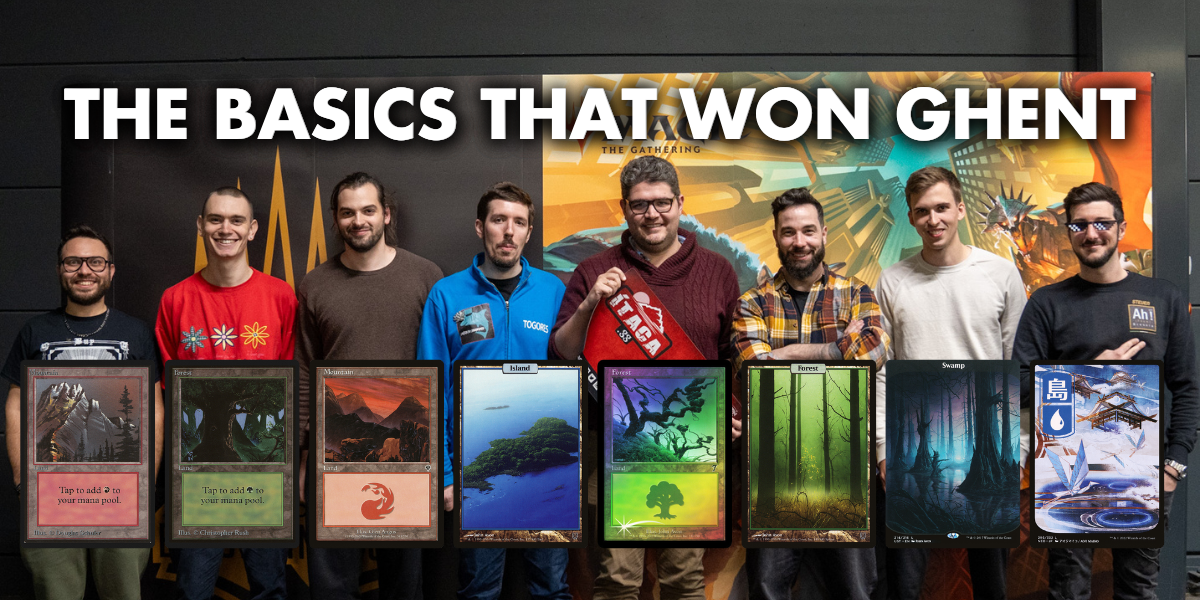
The latest season of the Legacy European Tour has concluded with Marco Del Pivo taking home the top spot for the Regional Championship for EMEA in Ghent. The biggest invite-only event in the history of the format, 948 eager Modern players sleeved up with big dreams. Only one could guarantee a spot at the Pro Tour — but every one of the top eight players, in addition to a nice cash prize, had the opportunity to show off their personal flair along the way in their selection of Magic’s most foundational resource: basic lands.
Currently, the Modern metagame hosts a little more than a dozen unique decks that are played with regularity at competitive events. While the exact lists can vary from player to player, for the seasoned pro who is optimizing their deck list for victory, the best way to represent one’s personal tastes and style is in their choice basic lands. Seven of our top eight players for the European Champs registered at least one basic Forest in their 75 — from which they had 320 unique pieces of art to chose from.
As we’ve discussed in our basic land coverage of previous events like the Pro Tour, the decklists posted online don’t include the specific style of basics used. This pivotal element is therefore left to the team here at Cardboard by the Numbers to assess for ourselves, combing over hours of footage to identify manually. We’ve done this for you, dear reader! And you can find the results here:

Island – LEB 292 | Mountain – LEB 297 | Forest – LEB 300
As far as power rankings go for basic lands, it’s hard to beat the classics, just as it’s hard to beat Marco Del Pivo when he’s piloting Temur Rhinos. It’s hard to find anything negative to say about his suite of lands: any of Mark Poole’s Islands stirs something in the soul of a Magic player, and Douglas Shuler’s Mountain is nearly as iconic. Marco pulling out the Beta basics is like someone who says their favorite movie is Lawrence of Arabia or The Godfather — a masterpiece is a masterpiece.
Marco previously showed up on our analysis of the basics of Pro Tour The Lord of the Rings running the same deck, Temur Rhinos. At that event, though, he was rocking a trio of lands from Mercadian Masques: quite the rogue choice for competitive Magic, but a commendable one nonetheless. While he’s “upgraded” his Modern deck’s suite of lands in the six months since that event in terms of prestige and price, I thought the Mercadian lands had a lot of character, and looked great alongside his Rhino tokens and Ketria Triomes.

Swamp – UST 214 | Forest – UST 216
Swinging into second place with the first borderless Magic cards for basics, Borja Yañez Carvajal’s Yawgmoth midrange list sported a pair of Unstable Forests and a Swamp from the same expansion. It’s hard to fault anyone for a John Avon land, particularly the ones from un-sets. The clean look and vivid colors are attractive and easily identifiable on camera — something that can’t be understated when this was one of the rare competitive Magic events that still gets a highly-produced livestream! Borja’s choice of lands may not match the old-border style he selected for his fetch or shock lands, but Unstable lands are the tuxedos of the land slot: they look good on anyone.

Swamp – 7ED 349 | Forest – 7ED 331
Daniel Toledo may be one of the most stylish yet. Brining the charm of the early 00s to the top tables, Daniel’s impressive third-place finish was accomplished with 7th Edition foils for the trio of basic lands in his Yawgmoth deck. Tony Szczudlo’s Swamp is, to me, the essential ideal of what a Swamp should look like, and the Forest from John Avon is one of the game’s creepiest, matching the aesthetic of the rest of Daniel’s 75.
7th Edition had two notable firsts: it was the first core set to provide new art for reprints, and it was the first reprint set to provide a black border for the premium versions of cards. In 2001 Magic terms, “premium” meant foil, but unlike with the foils of the modern era, these truly did feel “premium”. That’s premium quality is more than represented in the prices, as well. While the typical “foil multiplier” for a modern card is somewhere in the range of 1.2x the price of the standard version of a card, the typical multiplier for foils of this era is anywhere between 5-15x the price of the same non-foil. However, based on market price, the foil basic lands used here are nearly 20x the price of their non-foil equivalents!The numbers don’t lie: these lands are real prizes.

Island – LEB 291 | Mountain – INV 345
Nils Gutiérrez von Porat claimed the 4th place in the Regional Champs with an impressive showing piloting Izzet Breach, a deck that in turn had an impressive and notable combination of basic lands at the ready for Path to Exiles and Assassin’s Trophies. With a Mark Poole classic Island from the game’s Beta edition and one of the most-beloved Mountains in the game from Glen Angus in the Invasion block, Nils did what is rarely done in competitive events: he mixed and matched. As a Basic Land Radical, I appreciate mixing different styles of land with one another, and in this case, the “Tap to add U to your mana pool” text can be seen side-by-side with the bold Red mana symbol on the Invasion land, creating a cacophonous mana base. It’s a great look, if you ask me, and is simply leaning in to all of the bespoke designs Wizards of the Coast is throwing our way with dozens of new card styles and Secret Lairs every year.
For those who haven’t had the pleasure of playing with 30-year-old cardboard, Beta lands are typically preferred to Alpha, as cards from Limited Edition Alpha’s corners are more heavily rounded than all cards printed afterwards, making them liable to be called out in a tournament setting as “marked”. Though slightly more common, Beta lands often carry a premium for this reason and are among the most expensive basic lands on the secondary market.

Island – NEO 296 | Mountain – NEO 299 | Forest – NEO 302
From his profile picture here, it’s easy to see that Steven is too cool for school. It follows, then, that his basic land choice would similarly be the most hip option for 2024, and I would argue that Kamigawa: Neon Dynasty’s dual cycles of full-art basics in the style of Ukiyo-e are about as stylish as it gets. A mainstay of LGS tables in any format, these Neon Dynasty lands have kept up their appeal and spot among the best-selling lands of the year for two years running. We wouldn’t be surprised if they keep their lofty reputation far into the future, even with Booster Fun providing new full-art lands with each new expansion.

“If you don’t respect Tron, Tron won’t respect you!” – Toni Martos.
Running just one basic land in his tuned list — the classic Unhinged Forest — Toni seems to have respect for the classics. While auspiciously missing from the World Championship 2023 Top 8, the Unhinged basics, the game’s first real full-art cards, have been a mainstay in competitive Magic for 20 years and have been featured in Pro Tour Top 8s with more regularity than any other style.

Swamp – INV 341 | Forest – LEB 302
If I had a nickel for every time someone made the top 8 of the EMEA Regional Championship in a touristy town in Flemish Belgium with a combination of Beta and Invasion basic lands, I’d have two nickels. Which isn’t a lot, but it’s weird it’s happened twice!

Island – UNH 137 | Forest – UNH 140
As mentioned above in Toni’s section, choosing the Unhinged lands in your deck is anything but. John Avon was already one of the biggest names in basic land art prior to this cycle, but for the two-thirds of Magic history since their release, Avon’s art on these lands have become amongst the game’s most iconic.
Who do you think had the best taste in basics in Ghent? Let us know in the comments or on our social channels!
Thanks so much for reading. We have basic land coverage on the regular as well as new Magic: the Gathering infographics and analysis every week, so if you’ve enjoyed this article, sign up for our newsletter and be sure to follow us on Facebook, Instagram, Twitter, and Threads!!
Miles Atherton is the editor-in-chief of “Cardboard by the Numbers” and has been playing Magic since 2006. Since studying Agricultural Economics at UC Davis, he’s built a career as an award-winning marketing executive in the entertainment industry with a love of data journalism. He’s also written for Anime Buscience and Crunchyroll News, serving as Executive Editor of the latter from 2016 to 2021.
Leave a Reply